Indigenous healing NZ, primarily known as Rongoā Māori, is a holistic medicinal system that integrates the physical, spiritual, family, and environmental dimensions of health. To understand its full potential, start at Home or recognize its deep synergies with global indigenous philosophies, where wellness is inextricably linked to the vitality of the land, the guidance of ancestors, and the balance of energy systems.
The Foundations of Rongoā Māori
At the heart of indigenous healing NZ lies Rongoā Māori, a practice that transcends the Western definition of medicine. It is not merely the application of balms or the ingestion of tinctures; it is a way of being that aligns the individual with the natural world and the spiritual realm. In Aotearoa (New Zealand), traditional healing has survived centuries of colonization and suppression to emerge as a vital pillar of modern hauora (health/wellbeing).
Rongoā includes various disciplines, most notably rongoā rākau (plant remedies), mirimiri (bodywork and massage), and karakia (prayer and incantation). However, the efficacy of these treatments is rooted in mauri—the life force or vital essence present in all living things. A tohunga (expert practitioner) does not simply treat a symptom; they seek to restore the flow of mauri which may have been disrupted by physical trauma, spiritual transgression, or environmental disconnect, similar to the focus on healing in Arnica Montana: Trauma and Bruising.
Central to this system is the model of Te Whare Tapa Whā, developed by Sir Mason Durie. This model compares health to the four walls of a house: taha tinana (physical health), taha wairua (spiritual health), taha whānau (family health), and taha hinengaro (mental health). If one wall is missing or damaged, the house becomes unstable. This holistic perspective is the primary synergy that Rongoā shares with other indigenous healing practices worldwide.
Philosophical Parallels: Common Threads in Global Indigenous Wisdom
When we analyze indigenous healing NZ alongside practices from Native American, Aboriginal Australian, and First Nations Canadian cultures, striking philosophical parallels emerge. These synergies suggest a universal indigenous understanding of the human condition.
The Circle and the Cycle
Just as Māori utilize the four walls of Te Whare Tapa Whā, many Native American cultures rely on the Medicine Wheel. The Medicine Wheel is typically divided into four quadrants representing the four directions, the four seasons, and the four aspects of self (physical, mental, emotional, spiritual). Both systems emphasize that health is a dynamic balance. A blockage in the emotional quadrant of the Medicine Wheel is treated with the same gravity as a physical ailment, mirroring the Rongoā view that spiritual imbalance often manifests as physical illness.
Connection to Whenua (Land) and Country
For Māori, the connection to whenua (land) is absolute; the word itself means both ‘land’ and ‘placenta,’ signifying that the earth is the source of all nourishment. This is mirrored in the Aboriginal Australian concept of “Caring for Country.” In both traditions, the health of the environment is a direct predictor of the health of the people. You cannot heal an individual who is living on sick land.
This synergy is increasingly relevant in the context of planetary health. Indigenous healers globally are arguing that climate change is a health crisis, not just an environmental one. The revitalization of Rongoā in New Zealand involves not just treating patients but restoring native forests, protecting waterways, and re-establishing the reciprocal relationship between humans and nature, as we envision The Future of Integrative NZ Herbal Medicine.
Plant Medicine: The Synergy of Rakau and Global Herbalism
The botanical landscape of New Zealand is unique, having evolved in isolation for millions of years. However, the application of plant medicine in indigenous healing NZ shares methodologies with Traditional Chinese Medicine (TCM), Ayurveda, and Amazonian herbalism.
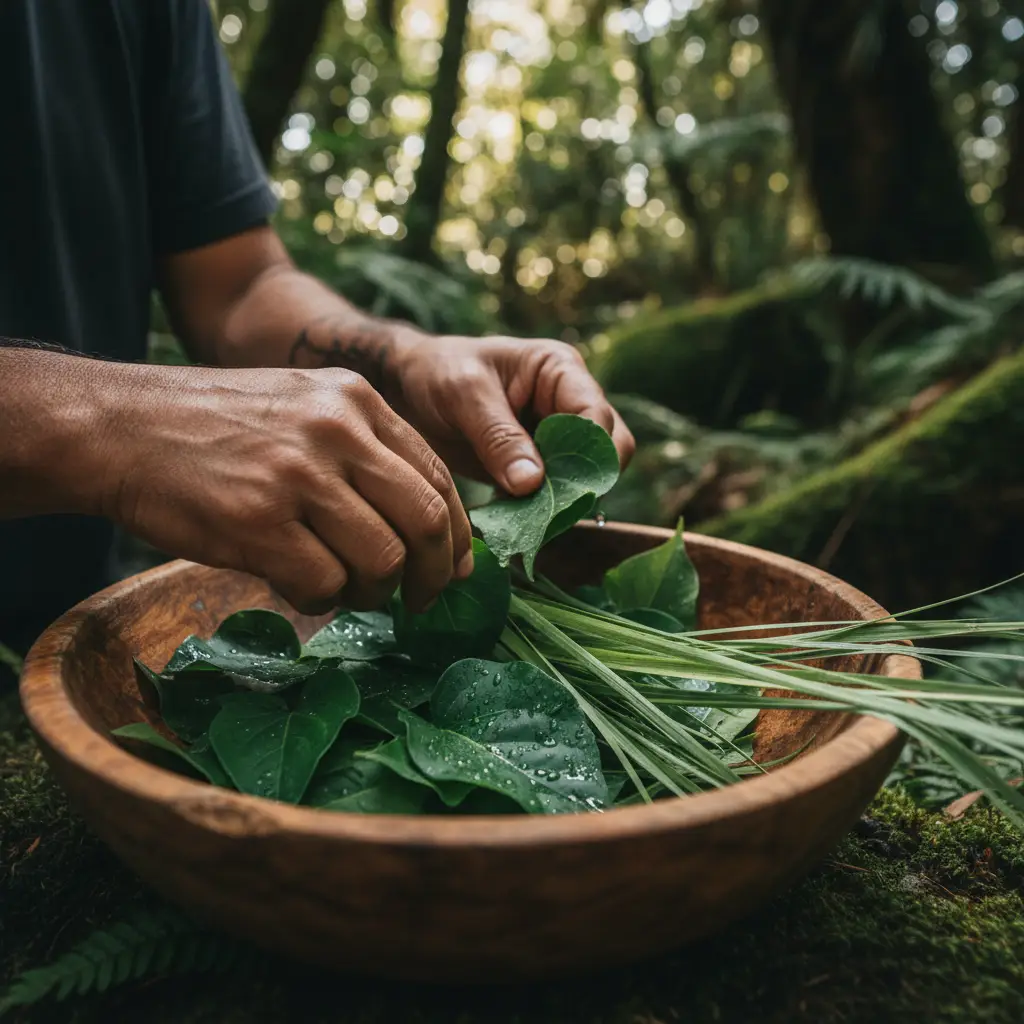
In Rongoā, plants are not viewed merely as biochemical factories. They are regarded as living entities with their own whakapapa (genealogy) and mauri. For example, Kawakawa (Piper excelsum) is used for inflammation, digestion, and pain. While science confirms its anti-inflammatory properties, a tohunga selects the leaves based on which side faces the sun and offers a karakia before harvesting, acknowledging the plant’s sacrifice.

This resonates deeply with Amazonian shamanism, where healers claim to learn the properties of plants through direct communication with the plant spirits during altered states of consciousness. Similarly, Ayurvedic practitioners classify herbs based on their energetic effects (heating or cooling) rather than just chemical composition. The synergy here is the “doctrine of signatures” and energetic matching—the idea that nature provides visual clues to a plant’s purpose, a concept found in Māori healing where the red sap of certain trees is associated with blood and circulation.
Respectful Learning and the Protection of Knowledge
As interest in indigenous healing NZ grows, so does the risk of biopiracy and cultural appropriation. This is a challenge shared by indigenous communities globally. The commercialization of white sage (sacred to many Native American tribes) serves as a cautionary tale for New Zealand regarding the commercialization of Manuka and Kawakawa.
The Significance of Wai 262
In New Zealand, the protection of this knowledge is encapsulated in the Wai 262 claim lodged with the Waitangi Tribunal. Often called the “Flora and Fauna Claim,” it asserts Māori rights over traditional knowledge and indigenous species. This legal framework is a pioneering model for other indigenous nations fighting to protect their intellectual property.
True synergy between healing systems requires “cultural safety.” This means that non-indigenous practitioners or patients must approach Rongoā with humility, acknowledging that they are guests in a system that belongs to the tangata whenua (people of the land). Collaboration is possible, but it must be led by indigenous experts to ensure the sanctity of the knowledge is maintained.
Addressing Global Health Challenges with Ancient Wisdom
The synergy between Rongoā Māori and other indigenous practices offers robust solutions to modern global health crises, particularly in areas where Western medicine struggles, such as chronic disease management, mental health, and antibiotic resistance.
Mental Health and Spiritual Disconnect
Depression and anxiety are often viewed in Western medicine as chemical imbalances. In contrast, Rongoā and other indigenous systems often view these conditions as a “loss of spirit” or disconnection from community and ancestry. By reintegrating patients into their community and reconnecting them with their genealogy (whakapapa), indigenous healing offers a path to recovery that pharmaceuticals alone cannot provide. The “social prescribing” movement in the UK is essentially a Western rediscovery of this ancient indigenous principle.
Antibiotic Resistance
With the rise of superbugs, the world is looking for new antimicrobials. New Zealand’s Manuka honey is famous for its non-peroxide antibacterial activity. Similarly, traditional healers in the Amazon and Africa possess knowledge of antimicrobial plants that have yet to be analyzed by science. The synergy here lies in the potential for “ethnobotany”—collaborative research that respects indigenous ownership while finding solutions for humanity.

The Future of Integrated Indigenous Healthcare
The future of healthcare in Aotearoa lies in a dual-system approach, where indigenous healing NZ is not an “alternative” but a legitimate, funded, and respected partner to clinical medicine. This is already happening in some hospitals where Rongoā practitioners work alongside surgeons and psychiatrists.
By fostering synergies with other indigenous healing practices, New Zealand can become a global hub for integrated medicine. This involves international knowledge exchanges where Māori tohunga meet with Aboriginal Ngangkari and Native American Medicine Men/Women to share strategies for preserving their arts in a modern world. These collaborations strengthen the collective voice of indigenous peoples, asserting that their healing modalities are not relics of the past, but sophisticated systems essential for the future survival of our species.
Ultimately, the power of Rongoā Māori lies in its ability to heal the separation between humans and nature. As we look to other indigenous traditions, we find the same truth echoed across oceans: to heal ourselves, we must heal the earth.
What is the main focus of Indigenous healing in NZ?
The main focus of Indigenous healing in NZ (Rongoā Māori) is holistic well-being. It treats the patient’s physical ailment (taha tinana) alongside their spiritual (taha wairua), mental (taha hinengaro), and family (taha whānau) health, often utilizing plant medicines and bodywork.
How does Rongoā Māori compare to other indigenous healing practices?
Rongoā Māori shares deep similarities with Native American and Aboriginal Australian practices, particularly regarding the connection between human health and the health of the land, the importance of spirituality, and the use of native plants for both physical and energetic healing.
Is Rongoā Māori recognized by the New Zealand healthcare system?
Yes, Rongoā Māori is increasingly recognized and funded within NZ’s public health system. The Accident Compensation Corporation (ACC) now funds Rongoā services for rehabilitation, acknowledging its validity and cultural importance.
What are some common plants used in Indigenous healing NZ?
Common plants include Kawakawa (used for inflammation, digestion, and skin), Manuka (antimicrobial and sedative properties), Harakeke (used for skin conditions and internal ailments), and Kumarahou (used for respiratory issues).
What is the concept of Te Whare Tapa Whā?
Te Whare Tapa Whā is a Māori health model developed by Sir Mason Durie. It visualizes health as a four-walled house representing physical, spiritual, mental, and family well-being. All four walls must be strong for the person to be healthy.
Can non-Māori people access or learn Rongoā?
Yes, non-Māori can access Rongoā healing. Learning the practice requires deep respect, cultural safety, and adherence to tikanga (protocols). It is generally expected that learners engage deeply with the culture and language, not just the botanical aspects.