Ayurveda NZ native plants refers to the integrative practice of classifying Aotearoa’s indigenous flora through the lens of Ayurvedic energetics, specifically the Tridosha (Vata, Pitta, Kapha) and Dravya Guna (pharmacology). By analyzing the taste (Rasa), potency (Virya), and post-digestive effect (Vipaka) of native species like Kawakawa and Manuka, practitioners develop a localized holistic health system that respects New Zealand’s unique ecosystem while utilizing ancient Vedic principles.
Bridging Vedic Wisdom and Aotearoa’s Flora
Ayurveda, the 5,000-year-old Indian “Science of Life,” is often mistakenly viewed as a system dependent solely on herbs from the Himalayas or the tropical forests of Kerala. However, the core philosophy of Ayurveda is universal: it teaches that nature provides the medicine required for the people living in any specific locality. For practitioners and wellness enthusiasts in New Zealand, this presents a unique opportunity to apply Ayurveda NZ native plants concepts to the rich, bioactive flora of Aotearoa, making this land a spiritual Home for holistic healing.
New Zealand’s native bush, traditionally the domain of Rongoā Māori (traditional Māori medicine), is teeming with plants that possess distinct energetic qualities. By observing these plants through the lens of Dravya Guna Vijnana (Ayurvedic pharmacology), we can identify their potential to balance the three biological humors: Vata (air/ether), Pitta (fire/water), and Kapha (water/earth). Those interested in sharing these benefits commercially should follow the Best Practices for Selling Herbal Products Online in NZ. This integration does not seek to replace Rongoā but rather to offer a complementary perspective for those living a Vedic lifestyle in the Southern Hemisphere, ensuring that their medicine is local, sustainable, and energetically aligned with their environment.
The Ayurvedic Framework: Adapting to the Southern Hemisphere
To successfully utilize NZ native plants within an Ayurvedic context, one must first understand the environmental context of Aotearoa. Ayurveda places immense importance on Desha (land/habitat). New Zealand is an island nation with a maritime climate that is often damp, windy, and changeable.
The Influence of Climate on Doshas
The New Zealand environment frequently aggravates Kapha (due to humidity and rain) and Vata (due to high winds and rapidly changing weather). Therefore, the native flora has evolved to survive these conditions, often resulting in plants that are hardy, warming, and protective—qualities that are medicinal for humans suffering from cold, damp, or mobile imbalances.
When analyzing a local plant, an Ayurvedic herbalist looks for:
- Rasa (Taste): Is it sweet, sour, salty, pungent, bitter, or astringent?
- Virya (Energy): Is the plant heating or cooling to the body?
- Vipaka (Post-Digestive Effect): What is the long-term effect on the tissues?
- Prabhava (Special Potency): Unique actions that cannot be explained by taste or energy alone.
Classifying NZ Native Plants by Dosha and Guna
The translation of local botany into Ayurvedic terms requires careful observation. Many New Zealand natives are rich in volatile oils, tannins, and alkaloids, making them potent medicines. Below is a comparative analysis of how specific NZ plants fit into the Tridoshic theory.
Kawakawa: The Heating Circulatory Stimulant
Botanical Name: Piper excelsum
Ayurvedic Correlate: Pippali (Long Pepper) or Black Pepper
Kawakawa is perhaps the most versatile plant in the NZ bush and aligns closely with the Ayurvedic concept of a Deepana (digestive fire kindler) and Pachana (digestive toxin burner). It belongs to the pepper family, sharing a lineage with the renowned Ayurvedic herb Pippali.
Energetics of Kawakawa
- Rasa (Taste): Pungent (Katu) and slightly Bitter (Tikta).
- Virya (Energy): Heating (Ushna).
- Dosha Effect: Pacifies Vata and Kapha; may aggravate Pitta in excess.
From an Ayurvedic perspective, Kawakawa is excellent for moving stagnant Vata and liquefying congested Kapha. Its warming nature stimulates Agni (digestive fire), making it an ideal tea for cold, damp NZ winters. It promotes circulation, alleviates bloating, and acts as a blood purifier (Raktasodhaka). However, due to its heating potency, those with high Pitta (inflammatory conditions, acidity) should use it with caution or blend it with cooling herbs like fennel or coriander.
Manuka: The Astringent Kapha-Buster
Botanical Name: Leptospermum scoparium
Ayurvedic Correlate: Similar to Neem or Khadir in action (though distinct in botany).
Manuka is world-famous for its honey, but the leaf and bark possess profound medicinal qualities. In Ayurveda, the astringent taste is the most drying and healing for wounds and mucous membranes.
Energetics of Manuka
- Rasa (Taste): Astringent (Kashaya) and Bitter (Tikta).
- Virya (Energy): Cooling to neutral.
- Dosha Effect: Strongly pacifies Kapha and Pitta; can aggravate Vata if used long-term due to dryness.
Manuka acts as a Stambhana (binding agent) and Krimighna (anti-parasitic/anti-microbial). It is ideal for Kapha conditions involving excess mucus, oiliness, or infection. The bitterness helps cleanse the liver, while the astringency tones the skin and digestive tract. Manuka oil can be compared to Tea Tree but is often gentler on the skin, useful for Pitta-type skin eruptions (acne, eczema) when they are weeping or oozing (wet eczema). When preparing such remedies for retail, it is vital to adhere to Packaging & Labeling Requirements for NZ Herbal Products.
Horopito and Kumarahou: Potency and Purification
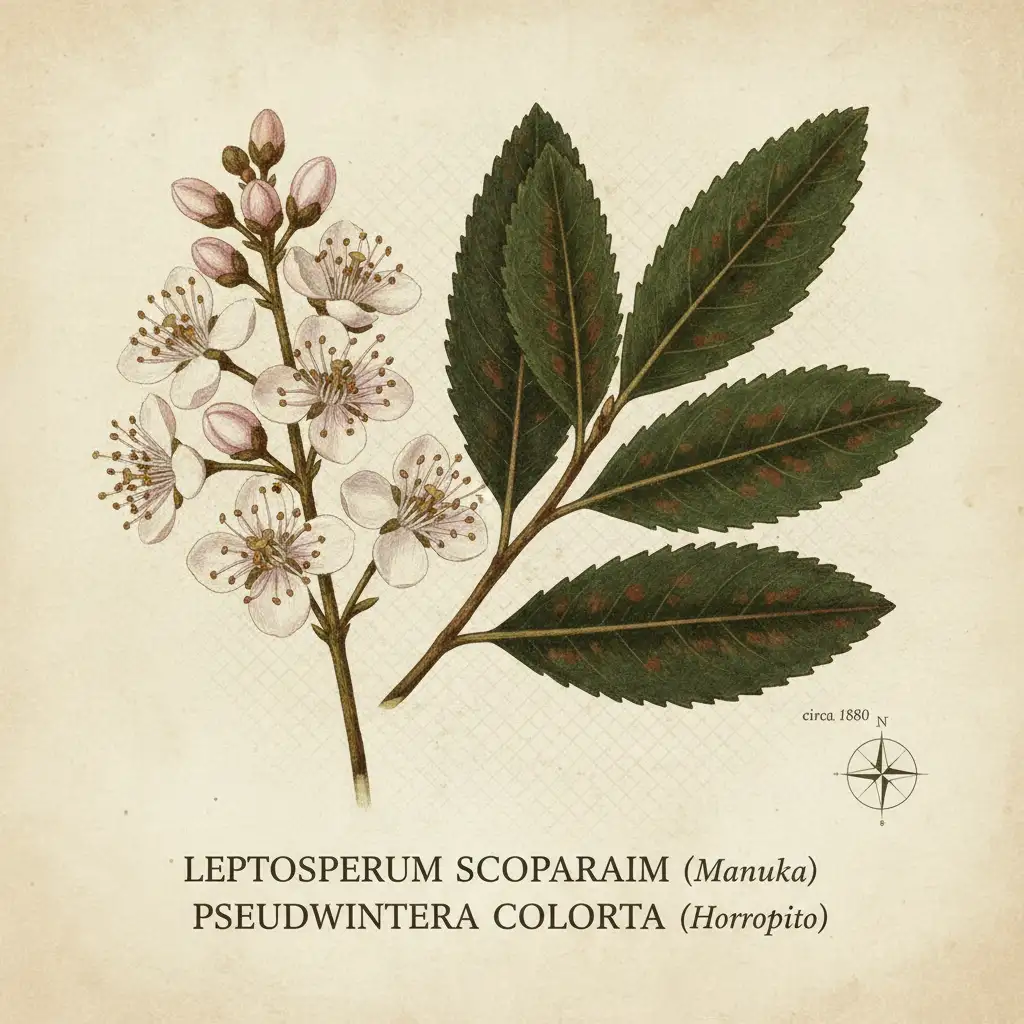
Horopito (Pseudowintera colorata)
Known as the “NZ Pepper Tree,” Horopito is intensely pungent. In Ayurveda, this level of heat is used to destroy pathogens and break up deep-seated congestion.
- Energetics: Extremely Pungent and Hot.
- Action: Krimighna (Anti-fungal/Anti-parasitic). It is a powerful remedy for Candida (a Kapha imbalance).
- Caution: This is a Rajasic (stimulating) plant. It strongly increases Pitta and should never be used on open, inflamed ulcers or by those with severe heat conditions. It is best used for cold, sluggish Kapha digestion or fungal infections.
Kumarahou (Pomaderris kumeraho)
Kumarahou is the “Gumdigger’s Soap,” known for its lathering saponins. In Ayurvedic terms, it is a premier lung tonic and blood purifier.
- Energetics: Bitter (Tikta).
- Action: Lekhana (Scraping). It scrapes accumulation from the respiratory tract and arteries.
- Dosha: Pacifies Kapha and Pitta. The bitter taste reduces toxicity (Ama) in the blood and supports liver function. It is an excellent alternative to Indian herbs like Kutki for respiratory health.
Creating Personalized Wellness Protocols
Applying Ayurveda NZ native plants requires a personalized approach based on your Prakruti (original constitution) and Vikruti (current imbalance). Here are strategies for integrating these botanicals into daily life.
For Vata Types (Air/Ether)
Vata individuals tend to be cold, dry, and anxious. The NZ climate can be harsh for them.
Strategy: Focus on warming, grounding plants.
Protocol: Drink Kawakawa tea with a dash of cinnamon and jaggery. Use balms infused with Titoki or warm Manuka oil for self-massage (Abhyanga) to soothe nervous energy.
For Pitta Types (Fire/Water)
Pitta individuals run hot and are prone to inflammation and acidity.
Strategy: Focus on cooling, bitter, and astringent plants.
Protocol: Use Manuka leaf infusions (cooled) as a skin wash for irritation. Drink Kumarahou tea (in moderation) to cleanse the blood during spring. Avoid Horopito as it will overheat the system.
For Kapha Types (Water/Earth)
Kapha individuals are prone to weight gain, congestion, and lethargy.
Strategy: Focus on heating, scraping, and stimulating plants.
Protocol: Horopito and Kawakawa are excellent allies. A strong decoction of Kumarahou helps clear chest congestion. Dry brushing (Garshana) followed by a sauna is beneficial, supported by spicy herbal teas.
Ethical Considerations: Tikanga and Ahimsa
When merging the wisdom of Ayurveda with the flora of Aotearoa, it is imperative to uphold the ethical principles of both traditions. Ayurveda teaches Ahimsa (non-violence) and respect for nature, while Māori culture follows Tikanga (protocols) regarding the harvesting of Rongoā.
Respecting the Whakapapa of Plants
Plants in Aotearoa are seen as taonga (treasures) and have their own whakapapa (genealogy). They are the children of Tāne Mahuta (God of the Forest). It is culturally inappropriate to treat them merely as chemical commodities. Before harvesting:
- Ask Permission: Offer a karakia (prayer) or acknowledgment to the forest.
- Sustainable Harvest: Never take more than you need. Leave the parent plant healthy (e.g., do not ring-bark trees).
- Cultural Safety: Acknowledge that while we are applying Ayurvedic lenses, the mana of the plant remains indigenous to Aotearoa.
For more information on the protection and respectful use of New Zealand’s biodiversity, refer to the Department of Conservation guidelines.
Furthermore, understanding the global context of traditional medicine is vital. According to Wikipedia’s overview of Ayurveda, the adaptation of principles to local environments is a historical tradition, yet it must be done without appropriating or erasing the indigenous knowledge that first identified the plant’s uses.

People Also Ask
Can I use Kawakawa if I have a Pitta imbalance?
Kawakawa is heating (Ushna Virya), which can aggravate Pitta (fire) if taken in excess. If you have a Pitta constitution or active inflammation (like acid reflux), use Kawakawa cautiously, perhaps blending it with cooling herbs like peppermint or fennel, or drinking it lukewarm rather than hot.
Is Manuka honey considered Ayurvedic?
Yes, honey (Madhu) is highly revered in Ayurveda as a “Yogavahi” (catalyst) that carries medicinal properties deep into tissues. Manuka honey, specifically, has potent antibacterial and scraping (Lekhana) qualities, making it excellent for Kapha imbalances and wound healing, though it should never be heated above 40°C as per Ayurvedic texts.
What is the difference between Rongoā Māori and Ayurveda?
Rongoā Māori is the traditional holistic healing system of New Zealand’s indigenous people, deeply rooted in spirituality (Wairua) and connection to the land (Whenua). Ayurveda is the traditional medicine of India, based on the Tridosha theory. While they share holistic principles, they are distinct systems with different diagnostic tools and cultural origins.
Which NZ native plant is good for anxiety (Vata imbalance)?
While few NZ natives are sedatives in the same way as Valerian, plants like Pukatea (specifically the bark) have analgesic and calming properties. However, for Vata anxiety, grounding practices using warm oils infused with calming natives or simply connecting with the stillness of the bush (Shinrin-yoku) is often prescribed alongside dietary changes.
How do I determine the Ayurvedic quality of a new plant?
Ayurvedic practitioners use organoleptic testing (using the senses). They taste the plant to determine Rasa (Sweet, Sour, Salty, Pungent, Bitter, Astringent), observe the immediate sensation (heating or cooling) for Virya, and monitor the long-term digestive effect for Vipaka.
Are there NZ alternatives to Ashwagandha?
There is no direct botanical equivalent to Ashwagandha (Withania somnifera) in the NZ bush that functions as an exact adaptogen and sedative tonic. However, a holistic practitioner might use a combination of nutrient-dense native tonics and seaweeds (like Kelp) to rebuild strength (Ojas), depending on the specific depletion.