
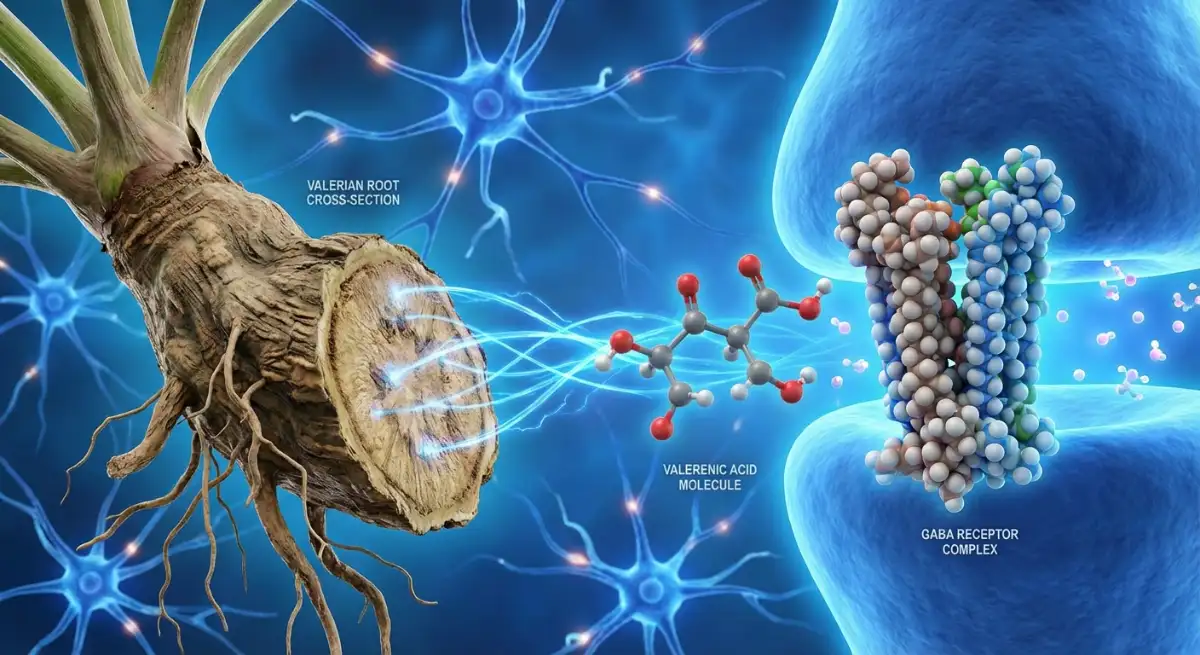
Valerian root mechanism of action centers on the modulation of gamma-aminobutyric acid (GABA) neurotransmission within the central nervous system. Its primary bioactive constituents, specifically valerenic acid and valerenol, act as allosteric modulators of GABA-A receptors, enhancing the influx of chloride ions into neurons. This hyperpolarizes the cell membrane, inhibiting neuronal excitability and reducing the time required to fall asleep (sleep latency) without significantly disrupting the natural architecture of sleep stages.
The Pharmacological Profile of Valeriana Officinalis
Valerian root (Valeriana officinalis) has stood as a cornerstone of botanical medicine for centuries, utilized historically to treat nervous restlessness and insomnia. However, in the context of modern integrative health, understanding the specific valerian root mechanism of action requires a deep dive into its complex phytochemistry. Returning to our Home for holistic health, we see that unlike synthetic pharmaceuticals which typically rely on a single active molecule, valerian root derives its therapeutic efficacy from the synergistic action of multiple chemical constituents.
The primary compounds responsible for its sedative and anxiolytic effects include sesquiterpenes (such as valerenic acid, valeranone, and kessyl glycol), iridoids (valepotriates), and flavonoids (hesperidin and linarin). While early research attempted to isolate a single “active ingredient,” contemporary pharmacological consensus suggests that these compounds work in concert to modulate neurochemistry.
Specifically, the volatile oils containing valerenic acid are stable and are often used as the standardization marker in high-quality extracts. For those interested in medicinal preparations, Tincture Making with New Zealand Herbs: Alcohol & Glycerine Extracts provides further detail. However, the valepotriates, though unstable and often degrading during storage into baldrinals, also possess significant sedative properties. This chemical complexity allows valerian to influence multiple pathways simultaneously, creating a “gentle” sedation profile distinct from the rapid, forceful knockout effect of benzodiazepines.
Interaction with GABA-A Receptors
The most substantiated mechanism by which valerian root induces sleep is through its interaction with the GABAergic system. Gamma-aminobutyric acid (GABA) is the primary inhibitory neurotransmitter in the mammalian central nervous system. When GABA binds to its receptors, it opens chloride channels, allowing negatively charged chloride ions to flow into the neuron. This influx lowers the neuron’s voltage (hyperpolarization), making it less likely to fire an action potential. In layman’s terms, it “quiets” the brain.
Allosteric Modulation
Valerenic acid does not bind to the active site of the GABA receptor (where GABA itself binds). Instead, it acts as a positive allosteric modulator. It binds to a specific subunit of the GABA-A receptor—most research points to the beta-3 subunit. By binding to this secondary site, valerenic acid changes the conformation of the receptor, increasing its affinity for GABA. This means that for the same amount of natural GABA present in the synaptic cleft, the inhibitory effect is magnified.
This mechanism is conceptually similar to how benzodiazepines work, but with a crucial distinction in binding affinity and receptor subtype selectivity. Valerian extracts have been shown to inhibit the enzymatic breakdown of GABA as well, potentially by inhibiting the enzyme GABA-transaminase. This dual action—enhancing receptor sensitivity and preserving synaptic GABA levels—creates a robust mechanism for reducing anxiety and inducing sleep.
Beyond GABA: Serotonin and Adenosine Pathways
While the GABA hypothesis dominates the literature regarding the valerian root mechanism of action, it does not paint the full picture. In the broader scope of Naturopathic Nutrition: Food as Medicine, we understand that multiple plant compounds must work together. Advanced assay screenings have revealed that valerian constituents interact with other critical neuroreceptors involved in the sleep-wake cycle.
Serotonin (5-HT) Receptors: Partial agonism of the 5-HT5A receptor has been observed with valerenic acid. The serotonin system plays a complex role in sleep regulation and mood stabilization. By modulating specific serotonin receptors, valerian may help reset the circadian rhythm and alleviate the anxious rumination that often prevents sleep onset.
Adenosine Receptors: Adenosine is a nucleoside that builds up in the brain during waking hours, creating “sleep pressure.” Caffeine works by blocking adenosine receptors. Conversely, certain lignans found in valerian root have been shown to bind to A1 adenosine receptors. This interaction mimics the natural accumulation of sleep pressure, signaling the body that it is time to rest. This multi-target approach explains why valerian is often effective for patients who do not respond to simple melatonin supplementation.
Impact on Sleep Architecture: Latency vs. Quality
One of the most significant advantages of valerian root over synthetic sedatives is its preservation of sleep architecture. Sleep is composed of distinct stages: Non-Rapid Eye Movement (NREM) stages 1-3 and Rapid Eye Movement (REM). Deep sleep (NREM Stage 3) is crucial for physical restoration, while REM sleep is essential for cognitive processing and emotional regulation.
Sleep Latency: Clinical trials consistently demonstrate that valerian root effectively reduces sleep latency—the time it takes to transition from full wakefulness to the first stage of sleep. This is the primary metric for efficacy in treating sleep-onset insomnia.
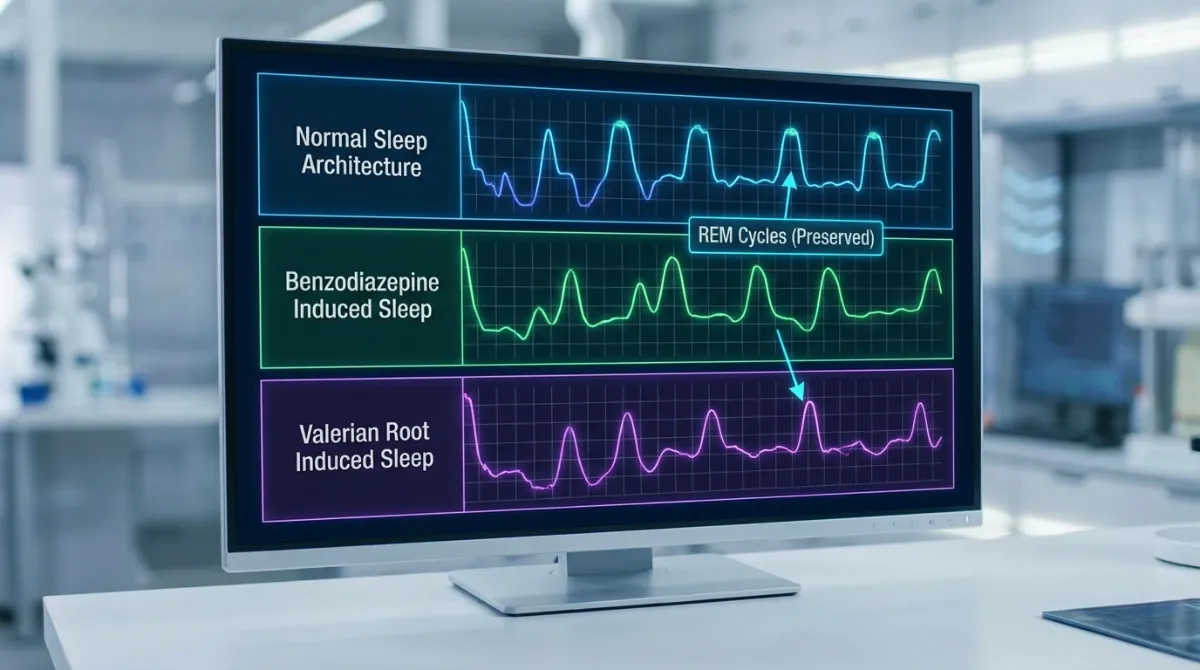
Sleep Quality and SWS: Many prescription sedatives reduce sleep latency but also suppress Slow Wave Sleep (SWS) and REM sleep, leading to a “light” sleep that leaves the user feeling groggy. Valerian root, by contrast, has been shown to maintain or even slightly enhance the percentage of time spent in SWS. Because it does not forcefully alter the hypnogram (the map of sleep stages), users report feeling more refreshed upon waking. This preservation of natural cycling is vital for long-term cognitive health.
Valerian vs. Melatonin and Prescription Sedatives
Understanding where valerian fits in the therapeutic hierarchy requires a direct comparison with other common sleep aids.
Valerian vs. Melatonin
Melatonin is a hormone, not a sedative. Its primary mechanism is chronobiological—it signals to the body that it is night. Melatonin is highly effective for circadian rhythm disorders (like jet lag or shift work) but is often ineffective for psychophysiological insomnia (anxiety-induced sleeplessness). Valerian, acting on GABA and adenosine, is a mild sedative. It is superior to melatonin for individuals whose sleep issues stem from stress, muscle tension, or an inability to “turn off” their racing thoughts.
Valerian vs. Benzodiazepines
Benzodiazepines (e.g., Xanax, Valium) are potent GABA-A agonists. While highly effective at inducing sleep, they carry severe risks: high potential for addiction, rapid tolerance buildup, and significant disruption of sleep architecture (REM suppression). Valerian acts on the same system but with much lower affinity and a ceiling effect that prevents fatal respiratory depression. For a comprehensive overview of herbal safety compared to pharmaceuticals, the National Center for Complementary and Integrative Health (NCCIH) provides extensive data on risk profiles.
Safety Profile, Liver Health, and Long-Term Use
In the integrative health niche, safety is paramount. A common misconception regarding valerian root is the risk of hepatotoxicity (liver damage). This concern largely stems from a confusion with Kava (Piper methysticum) or cases involving multi-herb supplements contaminated with other substances. Pure Valeriana officinalis has a high safety profile.
Liver Safety: Systematic reviews have found no significant evidence of liver toxicity when standard therapeutic dosages of valerian root are used. However, rare idiosyncratic reactions can occur with any botanical. It is generally advised that individuals with pre-existing liver disease consult a hepatologist before starting any herbal regimen.
Dependency and Withdrawal: Unlike benzodiazepines, valerian does not appear to induce physiological dependency. Withdrawal symptoms are virtually non-existent following the cessation of standard doses. However, because it affects GABA receptors, it is recommended to taper off usage after extended periods (months) rather than stopping abruptly, simply as a precaution to avoid rebound insomnia.
Dosage and Timing: To maximize the mechanism of action, valerian is best taken 30 to 60 minutes before bed. Because it can take time to build up synaptic efficacy, some clinical data suggests that optimal results are seen after 2–4 weeks of consistent use, rather than as a single-dose “rescue” medication.

Conclusion
The valerian root mechanism of action is a sophisticated interplay of GABAergic modulation, adenosine interaction, and serotonin partial agonism. By hyperpolarizing neurons via chloride channel modulation, it facilitates the transition into sleep without the heavy-handed sedation associated with pharmaceutical agents. For individuals seeking a natural intervention that respects the delicate architecture of human sleep cycles, valerian root remains a scientifically validated, authoritative choice in integrative medicine.
People Also Ask
Does valerian root increase GABA?
Yes, valerian root is believed to increase the availability of GABA in the synaptic cleft. It does this by stimulating the release of GABA and inhibiting the enzymes responsible for breaking it down, while also sensitizing GABA-A receptors.
Is valerian root hard on the liver?
Generally, no. Pure Valeriana officinalis is considered safe for the liver in healthy adults. Historical reports of liver toxicity were often linked to preparations mixed with other herbs or contaminants, though individuals with liver disease should exercise caution.
How long does it take for valerian root to work?
While some users feel a sedative effect within 30 to 60 minutes, clinical studies suggest that the full benefits for chronic insomnia often require 2 to 4 weeks of consistent nightly use.
Does valerian root affect dopamine?
There is no significant evidence suggesting valerian root directly modulates dopamine receptors. Its primary activity is focused on GABA, serotonin, and adenosine pathways.
Can you take valerian root with melatonin?
Many people combine them, as they work on different mechanisms (sedation vs. circadian rhythm). However, combining central nervous system depressants can lead to excessive grogginess, so it is best to consult a healthcare provider.
What is the half-life of valerian root?
The half-life of valerenic acid is relatively short, estimated at roughly 1.1 to 1.5 hours. However, the physiological effects on sleep architecture can persist throughout the night due to the downstream effects on neurochemistry.