
Baby formula FDA standards refer to the rigorous federal regulations mandated by the Federal Food, Drug, and Cosmetic Act (specifically under Section 412) and the Infant Formula Act of 1980. These standards enforce strict minimum (and sometimes maximum) requirements for 29 essential nutrients, ensuring safety, quality control, and proper labeling for all commercial formulas sold in the United States.
The Ironclad Rules: Understanding FDA Nutrient Requirements
For parents navigating the formula aisle, the sheer volume of options can be paralyzed. However, there is a comforting baseline: every single container of infant formula sold legally in the United States meets the same strict nutritional standards. Unlike supplements, which are loosely regulated, infant formula is one of the most highly regulated food products in the world.
The Food and Drug Administration (FDA) does not “approve” formulas in the same way it approves pharmaceutical drugs. Instead, manufacturers must register with the FDA and provide a notification prior to marketing a new formula. This notification must demonstrate that the product meets the requirements of the Infant Formula Act.
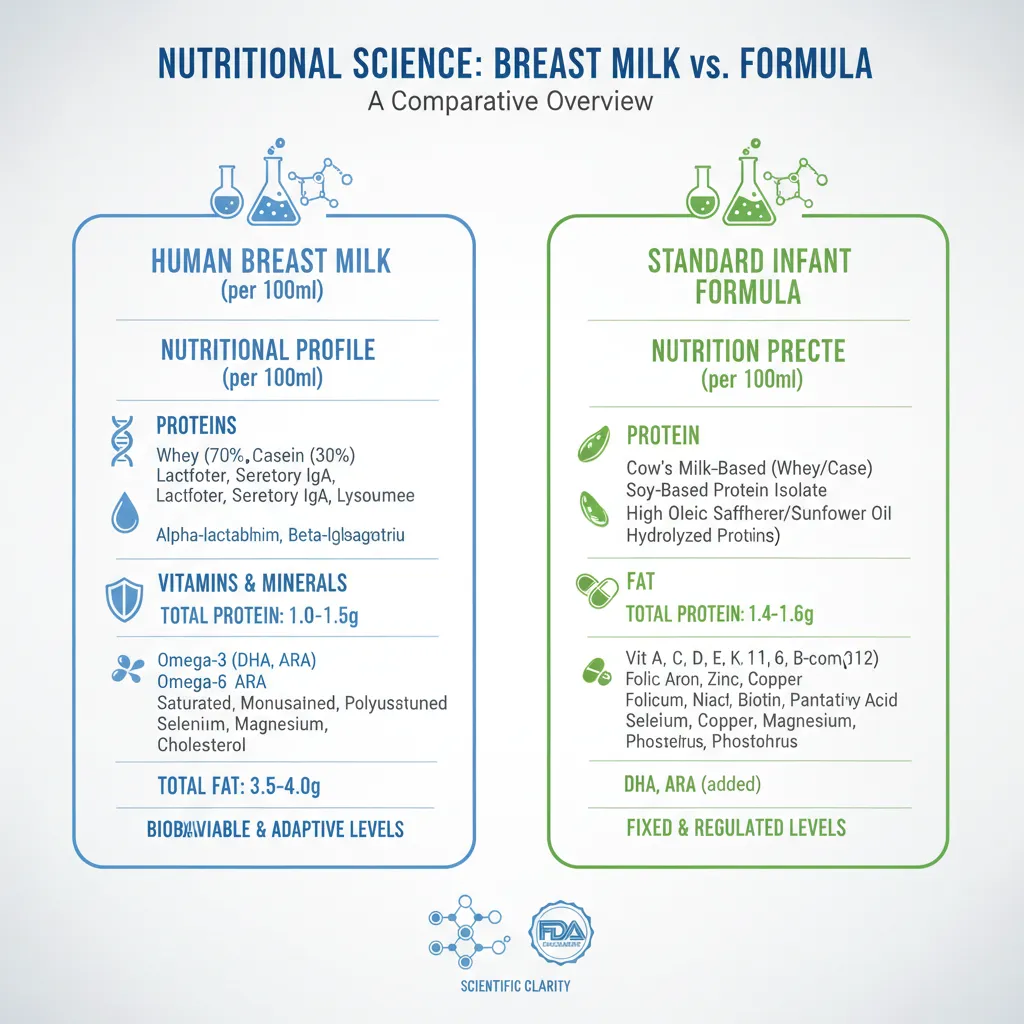
The “Big 29” Nutrients
To prevent malnutrition and ensure proper development, the FDA mandates specific ranges for 29 nutrients. These are not suggestions; they are legal requirements. If a formula fails to meet these minimums, it is recalled immediately.
- Protein: Must be within a specific range to support growth without overloading the infant’s kidneys. The source can be cow’s milk, soy, or hydrolyzed protein, but the biological value must be equivalent to casein.
- Fat: Required for brain development. The FDA mandates a minimum amount of linoleic acid (an essential fatty acid).
- Vitamins: Strict minimums for Vitamins A, D, E, K, C, B1, B2, B6, B12, Niacin, Folic Acid, Pantothenic Acid, Biotin, Choline, and Inositol.
- Minerals: Calcium, Phosphorus, Magnesium, Iron, Zinc, Manganese, Copper, Iodine, Sodium, Potassium, and Chloride.
It is important to note that while minimums are set for all these nutrients, maximum limits are only set for nine of them (including Vitamin A, Vitamin D, and Iron) to prevent toxicity. You can view the complete, granular list of nutrient specifications directly on the official FDA website.
Decoding the Label: Marketing Fluff vs. Clinical Reality
Once the baseline FDA standards are met, manufacturers differentiate their products through marketing claims. This is where science often gets blurred with sales tactics. Understanding what these terms actually mean—and what they don’t—is crucial for making an informed decision.
“Closest to Breast Milk”
This is perhaps the most common claim and arguably the most ambiguous. No formula is identical to breast milk, which is a living fluid containing antibodies, live cells, and dynamic hormone levels that change based on the baby’s needs. When brands claim this, they usually refer to the addition of specific ingredients like Lactoferrin or Milk Fat Globule Membrane (MFGM) that mimic components found in human milk. While beneficial, these are static additions to a processed product.
Organic and Non-GMO
The term “Organic” is regulated by the USDA, not the FDA’s nutritional branch. An organic seal certifies that the ingredients were grown without synthetic pesticides, genetically modified organisms (GMOs), or sewage sludge-based fertilizers, and that the cows were not treated with antibiotics or growth hormones.
Does Organic mean more nutritious? Generally, no. The vitamin and mineral content of organic formula is identical to standard formula because both must meet the FDA’s nutrient specifications. The value of organic lies in purity (fewer pesticide residues) rather than potency.
Hypoallergenic and Hydrolyzed
These terms have specific medical definitions. A “hypoallergenic” formula is usually extensively hydrolyzed, meaning the protein chains (casein or whey) have been broken down into tiny pieces so the infant’s immune system does not recognize them as allergens. This is legitimate science.
However, terms like “Sensitive,” “Gentle,” or “Comfort” are largely marketing terms. They often indicate a change in the carbohydrate source (e.g., swapping lactose for corn syrup solids to reduce gas) or a partially hydrolyzed protein. While helpful for some babies with minor digestion issues, they are not strictly regulated medical definitions.

Global Standards: US FDA vs. European Commission
In recent years, there has been a surge in American parents importing European formulas (like HiPP and Holle). This trend stems from a perception that European standards are stricter or “cleaner.” While both regions maintain incredibly high safety standards, there are distinct philosophical and regulatory differences.
Carbohydrate Sources
The most significant difference lies in sugars. The European Commission generally requires lactose to be the primary carbohydrate in cow’s milk-based formulas, mimicking the composition of breast milk. In the US, the FDA allows a wider variety of carbohydrate sources, including corn syrup solids, sucrose, and maltodextrin. While these are safe and provide necessary energy, many parents prefer lactose-based formulas to avoid added sugars that can impact taste preferences later in life.
DHA Requirements
As of recent updates, the European Union mandates the inclusion of DHA (Docosahexaenoic acid), an omega-3 fatty acid crucial for brain and eye development. In the US, adding DHA is voluntary, though most major brands now include it to remain competitive. However, the method of extraction differs; some US formulas use DHA extracted from algae using hexane, a solvent that some consumer advocacy groups wish to avoid.
Iron Levels
US formulas typically contain higher levels of iron compared to European formulas. The FDA requires higher iron levels to prevent anemia, whereas European regulations set lower maximums, believing that extremely high iron can contribute to constipation or bacterial growth in the gut. Both levels are considered safe, but this discrepancy often confuses parents.
Safety Protocols: Manufacturing and Recalls
The safety of baby formula goes beyond ingredients; it is heavily dependent on the manufacturing environment. Powdered infant formula is not sterile. This is a critical fact that many parents overlook. Because it is not sterile, it can harbor bacteria such as Cronobacter sakazakii or Salmonella if the facility is contaminated.
The Recall Process
Under the FDA’s Current Good Manufacturing Practices (CGMP), manufacturers must test every batch for Salmonella and Cronobacter before it leaves the facility. If a pathogen is detected in a facility or a product, a recall is initiated. The FDA monitors these facilities through periodic inspections.
Following the major recalls and shortages in 2022, the FDA has tightened its oversight, requiring more frequent reporting and better contingency plans for bacterial contamination. Parents should always check the lot number on the bottom of the can against the Recall.gov database or the manufacturer’s website before use.
Top Science-Backed Criteria for Choosing a Formula
Given the marketing noise and the regulatory safety nets, how should you choose? Based on nutritional science and pediatric consensus, here are the top criteria to prioritize over fancy branding.

1. Lactose as the Primary Carbohydrate
Unless your baby has a diagnosed lactose intolerance (which is rare in infants) or galactosemia, look for “Lactose” as the first ingredient. It has a lower glycemic index than corn syrup and supports the absorption of calcium and healthy gut bacteria.
2. Whey-to-Casein Ratio
Mature breast milk has a whey-to-casein ratio of roughly 60:40. Cow’s milk is naturally 20:80 (mostly casein), which forms a harder curd in the stomach and is more difficult to digest. High-quality formulas add extra whey to adjust this ratio, making it easier on a baby’s digestive system.
3. Prebiotics (HMOs)
Human Milk Oligosaccharides (HMOs) are the third most abundant solid component in breast milk. They feed the good bacteria in the gut and block pathogens. Look for formulas that include 2′-FL HMO, as this is the most researched prebiotic additive for immune support.
4. Avoidance of Palm Oil (Optional)
Many formulas use palm olein oil to mimic the palmitic acid in breast milk. However, clinical studies suggest that palm olein oil can form “calcium soaps” in the gut, potentially reducing calcium absorption and causing harder stools. Formulas using coconut, sunflower, or safflower oils often result in softer stools.
Conclusion: Navigating the Aisle with Confidence
Decoding baby formula requires looking past the pastel colors and “neuro-boosting” claims on the front of the can and turning strictly to the Nutrition Facts and Ingredients panel on the back. Whether you choose a generic store brand (which must meet the exact same FDA nutrient standards as name brands) or a premium organic import, the safety net of the FDA standards ensures your baby will receive adequate nutrition.
The best formula is ultimately the one that your baby digests well, that you can afford, and that is consistently available. By understanding the FDA standards, you can trade anxiety for authority, knowing that the science of safety is baked into every scoop.
What is the difference between FDA approved and FDA regulated formula?
The FDA does not “approve” infant formulas before they go to market in the way they approve drugs. However, formula is heavily “regulated.” Manufacturers must notify the FDA 90 days before marketing a new formula and prove that it meets the nutrient requirements of the Infant Formula Act. The FDA also conducts facility inspections to ensure safety compliance.
Is European baby formula better than American formula?
Not necessarily “better,” but different. European formulas often ban corn syrup solids and have different requirements for iron and DHA. Many parents prefer them for their stricter limits on certain additives and emphasis on lactose, but US formulas are equally safe and nutritionally complete according to clinical standards.
Are store-brand formulas as safe as name brands?
Yes. All infant formulas sold in the US, including generic store brands (like Target’s Up & Up or Walmart’s Parent’s Choice), must meet the exact same FDA nutritional standards and safety regulations as premium brands like Enfamil or Similac. They are often manufactured in the same facilities.
What ingredients should be avoided in baby formula?
While all FDA-allowed ingredients are safe, many parents prefer to avoid added sugars like sucrose or corn syrup solids unless the baby has a specific digestive need. Some also avoid palm olein oil due to potential constipation issues and reduced calcium absorption.
Does organic formula make a difference for babies?
Nutritionally, organic formula is very similar to standard formula. The main difference is the agricultural sourcing; organic formula ingredients are grown without synthetic pesticides or GMOs. If avoiding pesticide residue is a priority for your family, organic is a valid choice, but it does not offer “more” vitamins.
How do I know if a formula is FDA compliant?
If you are buying from a major US retailer (in-store or online), the formula is compliant. If you are importing formula from abroad via third-party sellers, it may not be FDA reviewed. To ensure compliance, check the label for the required “Nutrition Facts” panel format and ensure the product appears on the manufacturer’s official US website.