
Ayurveda science evidence is rapidly evolving, bridging the gap between ancient Vedic texts and modern systems biology. Research in fields like Ayurgenomics validates the concept of Prakriti (constitution) by correlating Doshas with specific genetic phenotypes, while studies in chronobiology confirm the efficacy of Dinacharya (daily routines) in regulating circadian rhythms. Furthermore, pharmacological analysis of Ayurvedic herbs demonstrates clear bioactive mechanisms, moving the discipline from folklore to evidence-based integrative medicine.
The Intersection of Ancient Wisdom and Modern Biology
For decades, Ayurveda was often dismissed by the western medical establishment as pseudoscience or mere folklore. However, the landscape of global health is shifting. As modern medicine begins to embrace personalized approaches—moving away from a “one size fits all” model—it is inadvertently converging with the fundamental principles of Ayurveda, which has championed personalized care for over 5,000 years.
The search for ayurveda science evidence is no longer about proving if the system works, but understanding how it works through the lens of molecular biology, genomics, and pharmacokinetics. This integration is giving rise to a new domain known as “Ayurvedic Biology,” where the holistic insights of the Charaka Samhita meet the rigorous scrutiny of the double-blind, placebo-controlled trial.
Today, integrative health practitioners are finding that Ayurvedic diagnostics often predate modern understanding of epigenetics and the microbiome. By examining the scientific validity of constitution (Prakriti), circadian alignment (Dinacharya), and formulation safety (Bhasmas), we can appreciate Ayurveda not just as tradition, but as a sophisticated, time-tested science of life.
Ayurgenomics: The Science Behind Prakriti
One of the most compelling areas of scientific validation for Ayurveda is the study of Prakriti, or individual body constitution. In Ayurveda, every individual is a unique combination of three Doshas: Vata, Pitta, and Kapha. For centuries, physicians have used these classifications to predict susceptibility to disease and prescribe treatments. Modern science is now validating this through a field called Ayurgenomics.
Genetic Markers and Dosha Types
Ayurgenomics explores the relationship between an individual’s Ayurvedic constitution and their genomic variations. A landmark study published in the Journal of Translational Medicine found distinct genetic differences between individuals of dominant Vata, Pitta, and Kapha constitutions. For instance, specific alleles related to inflammatory response and metabolism were found to cluster differently among the three groups.
- Vata Types: Research suggests a correlation with genes involved in cell cycle regulation and signaling, often linked to the nervous system’s excitability.
- Pitta Types: Genetic markers often point to high metabolic activity and oxidative stress regulation, aligning with the Pitta characteristic of high “fire” or digestion.
- Kapha Types: These individuals often show gene expression related to lipid metabolism and energy storage, explaining the Kapha tendency toward weight gain and stability.
This genetic validation transforms Prakriti from a metaphysical concept into a verifiable phenotype. It suggests that ancient Ayurvedic physicians were essentially performing early forms of phenotypic profiling, identifying genetic predispositions through observation and pulse diagnosis.
Chronobiology and Dinacharya: Regulating the Biological Clock
The 2017 Nobel Prize in Physiology or Medicine was awarded to scientists who discovered the molecular mechanisms controlling the circadian rhythm. This discovery provided massive scientific backing for the Ayurvedic concept of Dinacharya, or daily routine. Ayurveda has long taught that the body operates on a biological clock, with specific Doshas dominating different times of the day.
The Molecular Basis of Routine
Dinacharya prescribes waking before sunrise (Brahma Muhurta), eating the largest meal at noon (when Pitta/digestion is highest), and sleeping early. Modern chronobiology supports this entirely:
- Cortisol Awakening Response: Waking up early aligns with the body’s natural cortisol surge, promoting alertness and metabolic kickstarting.
- Digestive Fire (Agni) and Insulin Sensitivity: Science confirms that insulin sensitivity is highest during the middle of the day. Eating heavy meals late at night disrupts glucose metabolism and circadian genes, leading to metabolic syndrome—a fact Ayurveda warned against millennia ago.
- Autophagy and Sleep: The Ayurvedic emphasis on early sleep aligns with the body’s need for autophagy (cellular cleanup) and glymphatic system drainage (brain detoxification), which occur predominantly during deep sleep cycles aligned with darkness.
By following Dinacharya, practitioners are essentially entraining their peripheral clocks (in the liver and gut) with the master clock in the brain (suprachiasmatic nucleus), optimizing homeostasis.
Pharmacology: The Biochemistry of Ayurvedic Herbs
While the holistic philosophy is vital, the efficacy of Ayurveda also rests on its materia medica. Modern pharmacology is aggressively studying Ayurvedic herbs to isolate bioactive compounds and understand their mechanisms of action.
From Kitchen Spices to Clinical Compounds
Turmeric (Curcuma longa): Perhaps the most researched herb, its active compound curcumin has been the subject of thousands of peer-reviewed papers. It is a potent anti-inflammatory agent that inhibits the NF-kB molecule, which turns on genes related to inflammation. This validates its traditional use for wound healing and joint pain.
Ashwagandha (Withania somnifera): Classified as an adaptogen, modern research shows it helps the body manage stress by modulating the hypothalamic-pituitary-adrenal (HPA) axis. Studies have demonstrated its ability to lower cortisol levels, validating its use for Rasayana (rejuvenation).
For authoritative data on these herbs, the National Center for Biotechnology Information (NCBI) hosts extensive databases of studies confirming the immunomodulatory and anti-inflammatory properties of these traditional remedies.

The Science of Bhasmas: Nanomedicine or Toxicity?
One of the most controversial aspects of Ayurveda is the use of Bhasmas—calcined preparations involving metals and minerals like gold, silver, mercury, and lead. Critics often cite heavy metal toxicity, while proponents argue that the purification processes (Shodhana and Marana) transform these toxic metals into therapeutic agents. Modern science is shedding light on this through the lens of nanomedicine.
Herbo-Mineral Formulations as Nanoparticles
Research indicates that the rigorous incineration cycles (Puta) used to create Bhasmas reduce metals to the nanoparticle size (often 10-50 nm). At this scale, the physicochemical properties of materials change drastically.
- Bioavailability: Nanoparticles can cross cell membranes and the blood-brain barrier more effectively than bulk materials.
- Surface Area: The immense surface area of nanoparticles allows for targeted drug delivery at lower dosages.
- Toxicity Reduction: Properly prepared Bhasmas involve processing with herbal juices that may chelate the metals or alter their oxidation states, potentially rendering them biocompatible.
However, the line is thin. Poorly manufactured Bhasmas do pose a risk of lead or mercury poisoning. This highlights the critical need for Good Manufacturing Practices (GMP) and standardization in the Ayurvedic industry. The science supports the potential of Bhasmas as ancient nanomedicine, but only when strict traditional protocols are chemically verified.
Integration with Functional Medicine
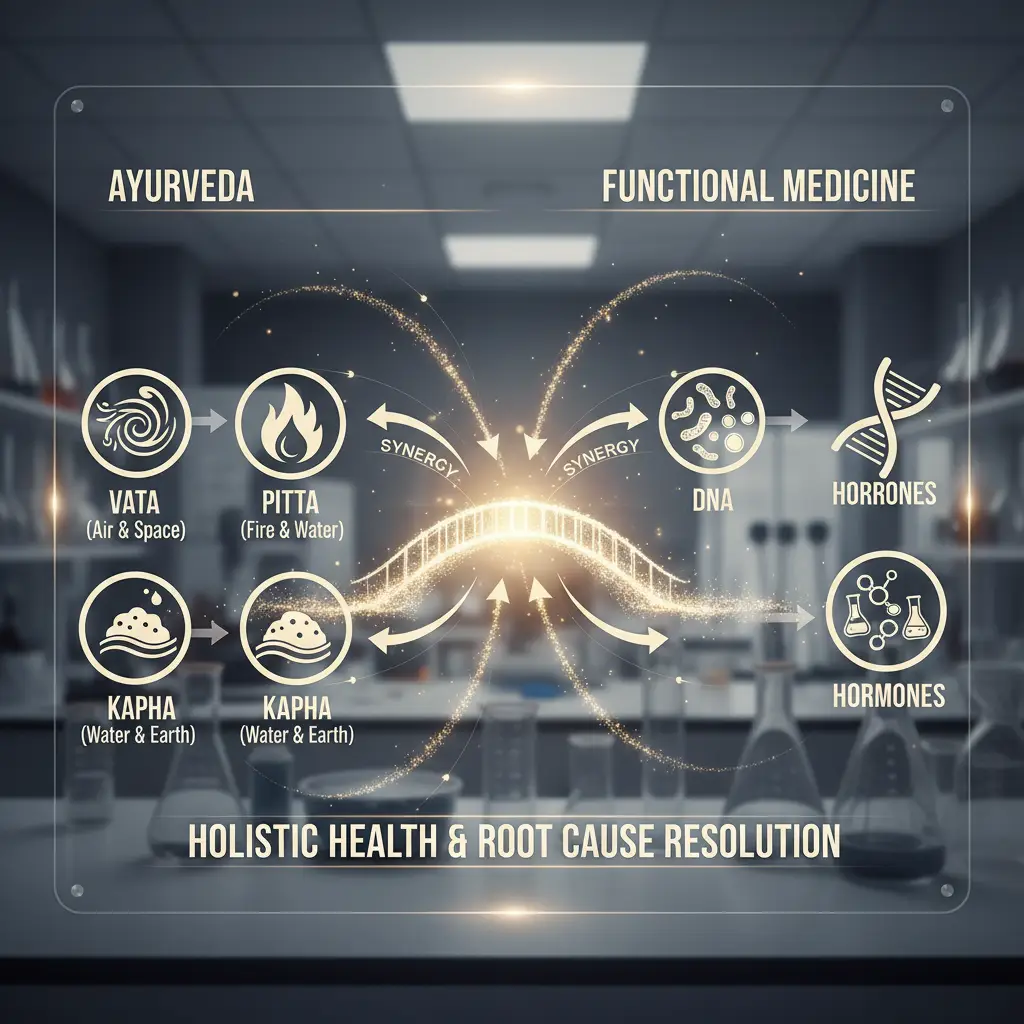
The convergence of Ayurveda and modern science is perhaps most visible in the rise of Functional Medicine. Both systems are systems-biology oriented, focusing on the root cause rather than symptom suppression.
Functional medicine utilizes lab testing (blood, stool, urine) to identify imbalances in hormones, nutrients, and the microbiome. Ayurveda utilizes clinical assessment (pulse, tongue, eye) to identify imbalances in Doshas and Agni (digestive fire). When combined, they offer a powerful toolkit:
- Gut Health: Both systems view the gut as the seat of health. Ayurveda’s focus on Agni parallels Functional Medicine’s focus on the microbiome and intestinal permeability (leaky gut).
- Detoxification: Ayurvedic Panchakarma therapies are being studied for their ability to mobilize fat-soluble toxins, which aligns with Functional Medicine’s focus on supporting liver detoxification pathways.
- Personalization: Both reject the statistical average in favor of the individual. A Functional Medicine doctor might prescribe a diet based on nutrigenomics, which frequently overlaps with a diet prescribed for a specific Prakriti.
Challenges and the Future of Ayurvedic Research
Despite the promising evidence, challenges remain. The “gold standard” of randomized controlled trials (RCTs) is difficult to apply to Ayurveda, which is inherently personalized. Giving the same herb to 100 people violates Ayurvedic principles if they have different constitutions. Therefore, researchers are developing “whole system” clinical trial designs that allow for individualized treatment within a controlled study.
Furthermore, standardization of raw materials is critical. Soil quality, harvest time, and processing methods affect the phytochemical profile of herbs. As the industry moves toward standardization, we can expect to see more robust ayurveda science evidence emerging.
In conclusion, Ayurveda is not antithetical to science; it is a science of complexity that is finally finding the technology capable of measuring it. By validating ancient wisdom with modern metrics, we are moving toward a future of truly integrative healthcare.
People Also Ask
Is there scientific proof that Ayurveda works?
Yes, there is growing scientific evidence supporting various aspects of Ayurveda. Clinical trials have validated the efficacy of specific Ayurvedic herbs like Turmeric and Ashwagandha. Additionally, the field of Ayurgenomics has established a genetic basis for the Ayurvedic body types (Doshas), and chronobiology supports Ayurvedic daily routines.
What does modern science say about Doshas?
Modern science, specifically Ayurgenomics, has found correlations between the three Doshas (Vata, Pitta, Kapha) and specific genetic metabolic phenotypes. For example, Pitta types often have different metabolic rates and inflammatory markers compared to Kapha types, validating the ancient classification system through genetic profiling.
Are Ayurvedic medicines FDA approved?
In the United States, Ayurvedic medicines are classified as dietary supplements, not drugs, so they are not “approved” by the FDA for treating disease. However, the FDA does regulate them for safety and labeling. It is crucial to buy from reputable brands that adhere to Good Manufacturing Practices (GMP) to avoid contamination.
Is Ayurvedic medicine safe for kidneys and liver?
Generally, herbal Ayurvedic treatments are safe when prescribed by a qualified practitioner. However, improper use of Bhasmas (metallic preparations) or adulterated supplements can cause toxicity. Studies show that standardized extracts of herbs like Punarnava can actually be protective for the kidneys, but quality control is essential.
How does Ayurveda relate to functional medicine?
Ayurveda and Functional Medicine share a core philosophy: treating the root cause of disease rather than just symptoms. Both emphasize gut health, detoxification, and personalized nutrition. Many Functional Medicine practitioners integrate Ayurvedic herbs and lifestyle interventions into their protocols.
What is the scientific basis of Panchakarma?
Scientific studies on Panchakarma (Ayurvedic detox) have shown that it can significantly reduce the levels of persistent organic pollutants (POPs) and pesticides in the blood. Research suggests it facilitates the mobilization of fat-soluble toxins, supporting the body’s natural metabolic detoxification pathways.